
Solid Geometry Representation Comparisons
On this page
The same shape can be stored in very different ways. This comparison uses a purpose-built chess pawn to show which information BRL-CAD retains, evaluates, or samples when moving among its principal geometry representations. It is a guide to semantics and conversion choices, not a claim that one representation is universally best.
Common model and method
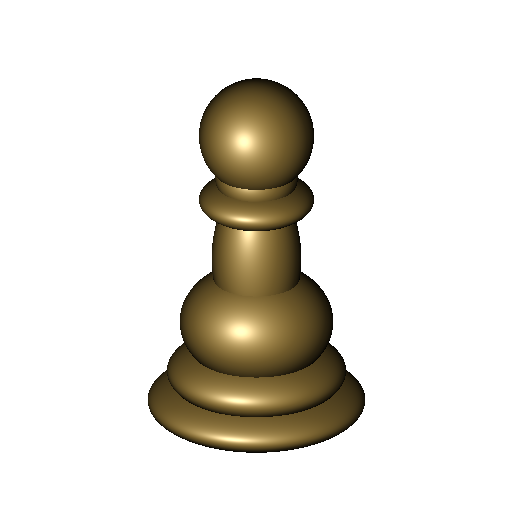
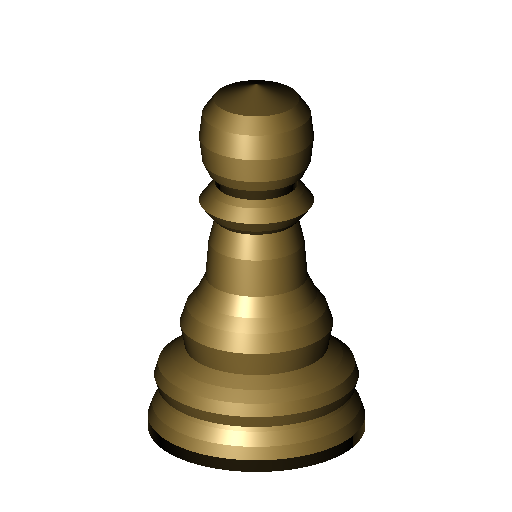
The reference pawn is a region containing seven overlapping ellipsoids. Their union is non-trivial enough to exercise curved surfaces, overlapping interiors, and several component boundaries while remaining reliable across the conversions shown here. The sketch-and-revolve version independently follows the same nominal profile; it is not an exact conversion of the seven-piece CSG model.
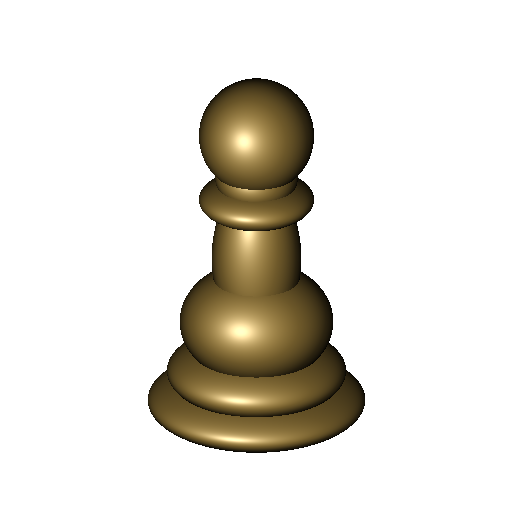
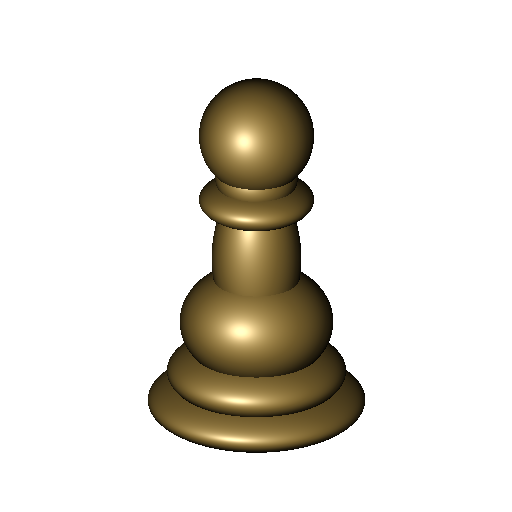
Every shaded image uses the same orthographic view, 512x512 image size, material, and single-threaded renderer. The wireframe uses the same view and image size. The faceting and sampling settings are intentionally coarse enough to remain visible. A similar silhouette therefore does not mean that two database objects have the same structure or numerical boundary.
|
Note
|
This article and its images are a committed snapshot. Developers can
regenerate the figures from built BRL-CAD tools by configuring with
-DBRLCAD_GENERATE_SOLID_REPRESENTATION_COMPARISON=ON and building the
solid-representation-comparison-snapshot target.
|
At a glance
| Form | BRL-CAD storage | Solid? | Boolean state | Editing and conversion consequences |
|---|---|---|---|---|
Analytic CSG |
Seven |
Yes |
Retained |
Compact primitive parameters and tree edits preserve construction intent. |
B-rep tree |
Closed |
Yes |
Retained |
NURBS surfaces and trims replace analytic leaves, but the assembly tree remains. |
Evaluated B-rep |
One closed |
Yes |
Evaluated |
Direct face, edge, trim, and control-point editing is possible; original features and hierarchy are gone. |
Polygonal tree |
Solid-mode |
Yes |
Retained |
Leaf tessellation is approximate, but components and their union tree remain independently replaceable. |
Evaluated NMG |
One |
Yes |
Evaluated |
Stores explicit, topology-rich polygonal boundaries and can record non-manifold relationships. |
Evaluated triangle mesh |
One solid-mode |
Yes |
Evaluated |
Portable triangle connectivity, but curved geometry and construction history have been sampled away. |
Sketch and revolve |
One |
Yes |
Not needed here |
The profile, axis, and sweep angle are compact, meaningful parameters. |
Voxel cells |
A region containing many |
Yes (sampled) |
Cell union retained |
Individual cells are ordinary CSG geometry; size grows rapidly as cells shrink. |
Sampled volume |
A file-backed |
Yes (thresholded) |
None |
Compact regular-grid occupancy; resolution and threshold determine the boundary. |
Point cloud |
One |
No pawn interior |
None |
Useful as measured or sampled evidence, but it has no inherent connected boundary or inside/outside rule. |
Wireframe |
Derived line display of the CSG object |
No |
Uses source tree |
A view-dependent drawing aid, not an independent solid representation. |
"Solid" in this table means that the stored object supplies usable
inside/outside semantics for the pawn. An arbitrary B-rep or mesh is not
automatically a solid: its boundary must be closed and consistently oriented.
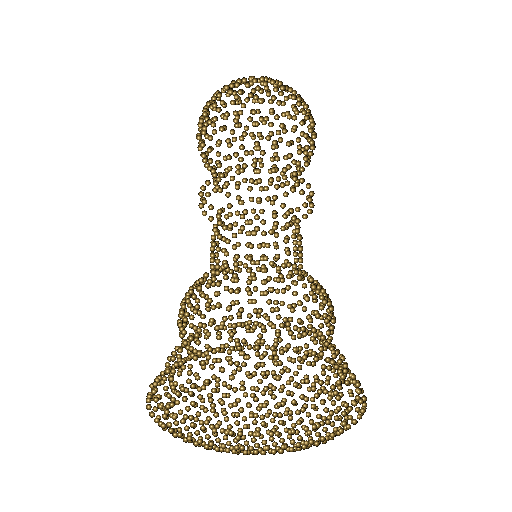
The point size used to render pnts makes each sample a small sphere, but those
spheres do not reconstruct the pawn interior. A wireframe likewise does not
become a solid merely because its curves appear closed in one view.
Implicit and parametric forms
|
|
Analytic CSG. Native primitives retain their equations and dimensions; the region evaluates their union during ray tracing. |
Sketch plus revolve. A closed line-segment profile is swept through 360 degrees. The stepped profile is intentional and remains editable in two dimensions. |
Analytic CSG is an implicit representation: intersections with ideal primitive surfaces are computed as needed rather than read from a stored boundary mesh. It is usually the most compact form here and makes edits such as changing the head radius or stem proportions direct. Its Boolean hierarchy also records why the shape was assembled.
sketch plus revolve is another procedural, parameterized description. It
works especially well for an axisymmetric part, although a sketch with only
line segments produces conical and cylindrical bands rather than the pawn’s
original ellipsoidal surfaces. BRL-CAD supports primitive parameters, placement
matrices, sketches, and sweeps; that should not be confused with a general
constraint solver or an associative feature-history system.
Spline boundary representations
|
|
B-rep with Booleans. Each analytic leaf becomes a closed B-rep whose boundaries are trimmed NURBS surfaces. The original union tree is retained. |
B-rep without Booleans. Boolean evaluation produces one explicit boundary; operand identities and the construction tree no longer exist as editable features. |
A B-rep stores faces, trims, edges, vertices, and their topology explicitly.
Rational NURBS can represent the source quadrics exactly as surfaces, but that
does not make every CSG-to-B-rep conversion exact: intersections, trimming,
topology classification, and repair use numerical tolerances. Keeping a tree
of B-rep leaves isolates conversion to each primitive and retains high-level
editing. Evaluating the tree yields a more self-contained boundary for
exchange and face-level work, at the cost of that history. This snapshot’s
evaluated result passes both brep … valid and brep … solid; conversion
results should be checked rather than assumed to be closed.
Polygonal boundaries
|
|
|
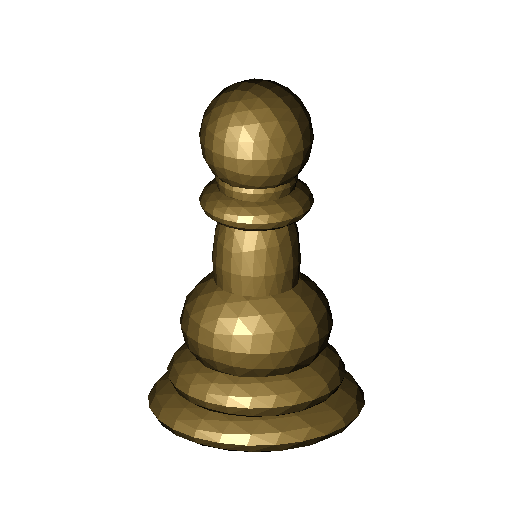
Polygonal with Booleans. Each leaf is independently tessellated to a BoT, then placed in the original union tree. |
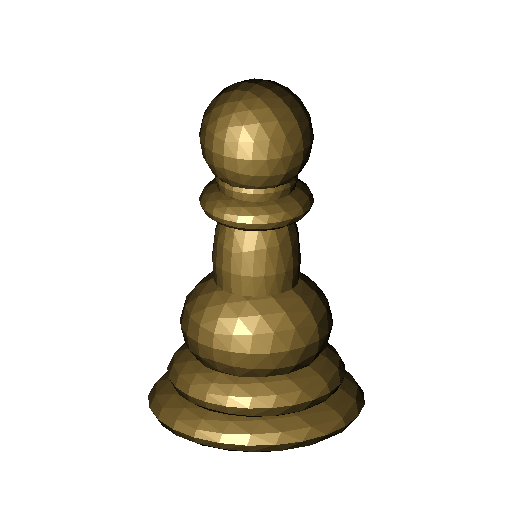
Evaluated NMG. One non-manifold geometry object records the evaluated polygonal boundary and its richer topology. |
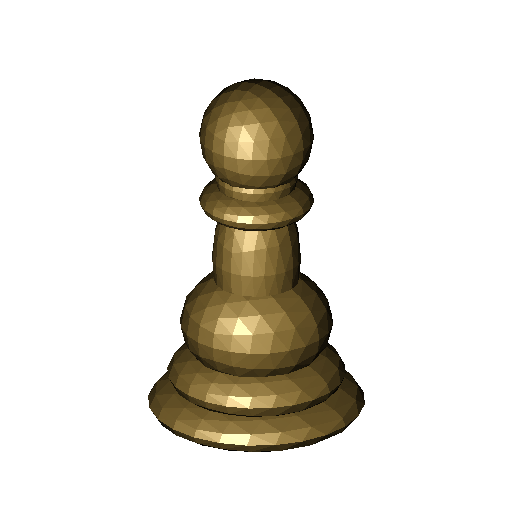
Evaluated triangle mesh. One solid, counter-clockwise BoT stores 982 vertices and 1,960 triangular faces in this snapshot. |
All three images expose the same coarse tessellation. Their similar appearance hides an important distinction: the first still has seven editable operands, whereas the NMG and single BoT are evaluated results. NMG can represent polygonal faces and non-manifold adjacency; BoT faces are triangles only. Neither recreates analytic curvature when converted back. Finer tessellation reduces visible error but increases storage and processing cost.
Sampled forms
|
|
|
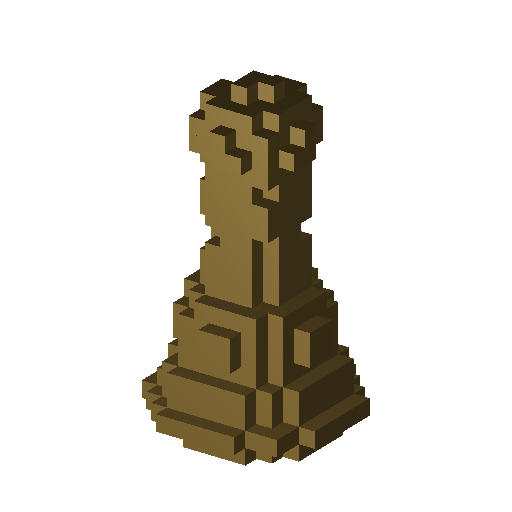
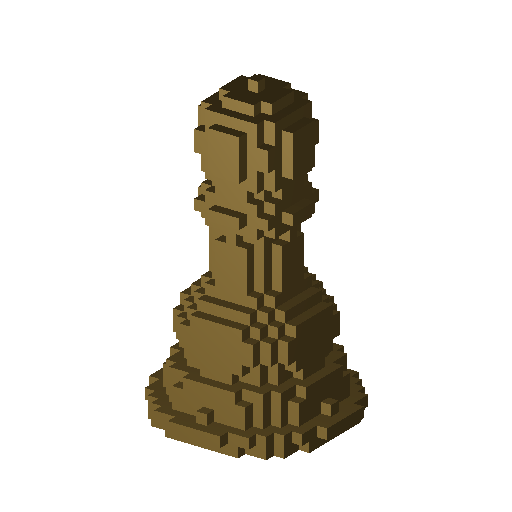
Explicit voxel cells. |
Sampled volume. |
Point cloud. |
The two voxel images are deliberately separate. The voxelize command emits
ordinary box primitives and a combination, while vol reads scalar samples on
a regular grid and derives a threshold boundary at ray-trace time. Both are
volumetric approximations whose accuracy, memory, and feature size depend on
cell spacing. A point cloud samples only the surface and has no connectivity;
surface reconstruction requires additional assumptions and may invent or omit
geometry.
Wireframe display
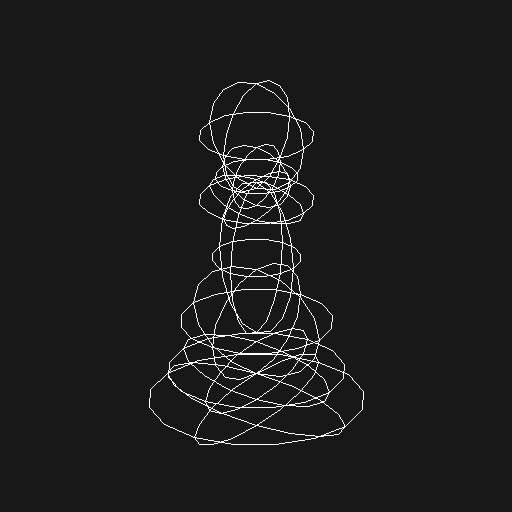
This wireframe is a view-plane plot of MGED’s unevaluated display of the analytic CSG pawn; hidden lines are not removed. Wireframes are useful for selection, orientation, and seeing component curves, but they are ambiguous: curves alone do not say which side is material, which loops bound faces, or which surfaces enclose volume. Keep the solid that generated the display rather than treating the drawing as an equivalent conversion target.
Conversion and editing consequences
A conversion command is not an equivalence guarantee. Before replacing source data, check at least these effects:
-
Tolerance and resolution: B-rep Boolean evaluation uses intersection and topology tolerances; tessellation uses chord and angular tolerances; voxels and points use sample spacing and thresholds. Each can erase a feature smaller than its controlling tolerance.
-
Construction intent: evaluating a Boolean tree discards operand identity, primitive parameters, and ordering. Converting leaves while retaining the tree keeps more of that intent.
-
Topology: a visually plausible B-rep or mesh may contain gaps, duplicate faces, self-intersections, or inconsistent orientation. Validate closure and ray behavior, not only a shaded image.
-
Attributes: collapsing a hierarchy may change where region identifiers, materials, colors, and other attributes reside. Verify them separately from geometry.
-
Round trips: CSG to mesh to B-rep does not recover the original equations; points to a surface requires reconstruction; resampling a volume compounds discretization. Retain the highest-level trustworthy source.
For parameter changes and repeated design work, prefer analytic primitives, sketch sweeps, and preserved combination trees. Prefer a validated B-rep when trimmed-surface topology or exchange requires it. Use NMG for topology-rich polygonal processing and BoT for triangle-oriented interchange or algorithms. Use voxels for occupancy operations and point clouds for measured or sampled data, not as silent substitutes for a watertight solid.
BRL-CAD also supports specialized forms such as DSP height fields, EBM
extrusions, ARS surfaces, metaballs, and legacy poly and bspline objects.
They are not shown as interchangeable pawn encodings: DSP and EBM are
domain-specific, metaballs change the modeling method, and BoT and B-rep are the
preferred general successors to the legacy polygon and spline forms.
Reproducing the conversions
The snapshot generator creates the database and runs these principal MGED operations (names shortened here only where noted):
brep comparison.csg.r brep --no-evaluation
brep comparison.csg.r brep comparison.brep_evaluated.s
facetize -n comparison.csg.r comparison.nmg.s
facetize --methods NMG comparison.csg.r comparison.bot.s
facetize --methods NMG base.s base.bot        # repeated for all seven leaves
voxelize -s "3 3 3" -d 4 -t 0.45 comparison.voxel_cells.r comparison.csg.r
pnts gen -t 2 --surface --grid comparison.csg.r comparison.samples
pnts write comparison.samples comparison.xyz
pnts read -f xyzijk --size 0.45 comparison.xyz comparison.point_cloud.s
The generator also runs g-voxel and expands its sparse occupied-cell report
into the x-fastest byte array used by vol. It then renders every shaded
object with rt -B -M -P1 and the saved view; MGED’s plot -2d, plot3-fb,
and fb-png produce the wireframe image. See
solid_geometry_comparison/generate_comparison.cmake and
solid_geometry_comparison/create_pawn.tcl for the complete reproducible
inputs.